
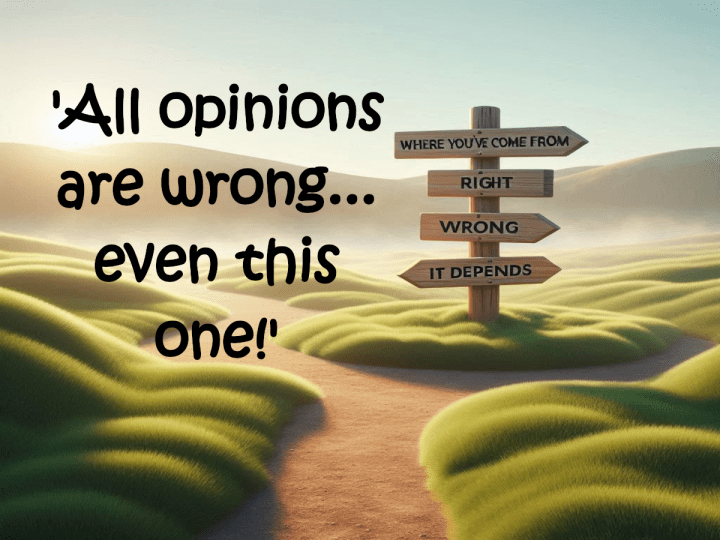
An opinion is a judgment based on as little or as much data as the opinion-maker wants to use. Sometimes, ‘the fewer the facts, the stronger the opinion’1. Alan Watts proposed that judgments are made by reviewing as much data as you can get your hands on, and then making a kneejerk decision anyway2. You can never have all of the data. So it goes that if all opinions are arguable (even this opinion), by questioning them, forming conversations, we are veering closer towards what is factual, towards the truth. We may never get all the way, but it holds better than sticking to your guns at all cost. Once you take a hard stance on anything, you can only be right for as long as the assumptions hold true, or until the definition is changed (or let’s face it, you may have just been wrong all along).
‘All opinions are wrong… even this one.‘
Though I often joke that ‘all opinions are wrong… even this one’, it does make me wonder how serious a statement that this may be. It has so often made more sense than not. You may think that, of two polar opposite opinions, one must be right? Perhaps, not. Maybe the truth lies somewhere in between. You may think that of all opinions, many must be correct. Perhaps, at a certain point in time an opinion may prove to be the truth, but over time there will be exceptions or it will cease to be true, or evidence may arise that you were barking up the wrong tree. Almost every opinion I held as a teenager has either proven wrong, or has had too many exceptions for it to be held as a solid rule over time.
‘All conversations are correct… even this one.‘
The equal and opposite of this statement could as easily be true: ‘All conversations are correct… even this one.’ If a discussion between two or more parties goes nowhere and all parties learn nothing, it was useful in achieving that alone. Without the conversation, no one would have known that it would lead to no new knowledge or beliefs. If a discussion, in which opinions are raised, and one or more of the parties involved evolves some of their beliefs, then the conversation was useful in bringing knowledge and beliefs closer to the truth. If a discussion leads to a breakthrough toward the ultimate goal of truth, then it is also a (or possibly ‘the most’) useful use of a conversation.
It is also comforting (for some) to know that even the facts are often arguable. Look at poor Pluto (to be blatantly obvious). In this case a change in the definition of a planet by the International Astronomical Union based on new information, means that even facts must adapt. Then there’s the whole notion of taxonomical facts that have been tested by the uncovering of genetic code. The once false gharial, which was classified as a crocodile, is now known to be an actual gharial (now called a Malayan gharial). And our understanding of physics is now at a similar impasse. The latest forays into the quantum world might have Newton looking at apples in a different light. I suppose we can only call a spade a spade if we all agree on the rules of a spade, and even still that agreement may be overturned at some point.
Perhaps you remember at school debating they separated teams into ‘the affirmative’ and ‘the negative’. You didn’t choose which team you’re on. It’s assigned by a convener. Then you had to argue a point that you may or may not agree with. Either way, you found useful points, usually based on rhetoric, to persuade the judge/s that your argument outweighed your opponents’. It’s a forced way to adopt a new point of view and it can be done with any of your current opinions if needed, if only to look at an argument from someone else’s shoes.
Often we are persuaded by the most attractive argument. Aristotle’s three pillars of rhetoric (whether we know this or not) are the most used in persuasion, by media, lawyers and politicians. Logos (or logic) should be enough, but is often negated by the more powerful Pathos (or emotion). If I feel emotionally attached to an idea, this almost always supersedes the logical explanation of a counter-idea. In this world of influencers and celebrity, the notion of Ethos (or ethical appeal) can trump both logic and emotion, or lead to us creating false logic to support our belief in one human being’s argument. It’s astonishing that if Taylor Swift endorses a presidential candidate the swing could be larger than 1% (based on polls) which is huge 1.6 million people outsourcing of their views to one human being (as great as she may be).
While on the topic of voting, over 81% of teenagers follow the political loyalty of their parents (more if they’re Democrats) in the US3. It’s no surprise the numbers are similar for religious beliefs, and it would be less surprising if this extended to other areas of beliefs.
Which leads us to the age-old concept of confirmation bias. Often opinions arise from our upbringing, but also from articles which we choose to read (or news channels we watch). Subscription to a certain newspaper can often lead to subscription to a point of view. And once you have made your opinion known, it is often that you look for information that confirms said opinion. In this technological revolution, AI’s learn what the user wants to see and hear and read, from what we’ve seen and heard and read (and possibly said) and sends us the clips and articles to confirm this.
Another red flag to look out for is oversimplification. The recent debate about climate change often conflates the measurable effects of natural versus human-made climate change, even on political stages. Oversimplification usually occurs because humans need labels (which I will write about separately in a not-too-distant post). Even world leaders are often lost in the debate, forgetting which type of climate change they are referring to. Labels need simple descriptors, and even the descriptors are mini-labels. To fit into a label we need to broadly generalise descriptors to fit the label. For each descriptor or label again we need to agree on the descriptors of them. From the descriptors of the definition of a ‘spade’ we could draw many differing objects, for example. Climate change has always occurred if
Having an opinion is just fine. Everyone is entitled to have one. I still have moments of them. As Madonna put it, ‘Everyone is entitled to my opinion’4. Though she said it flippantly, I believe this to be factual. Or is it just another opinion?
Either way, I have just given you some of my opinions on ‘opinions’. I haven’t presented all of the angles. I chose which angles to focus upon. I chose which data to use to propose this (bias). I used ‘labels’ to illustrate what is wrong with using labels. However, I guess that I am just showing you that if you have the tools to figure out whether your opinion might have its misgivings, then you can choose whether to hang onto your opinion, or simply allow it to become a moving stance, a conversation that allows new information to update your still malleable stance on a topic.
How to test your opinion:
Think of an opinion that you hold dear to your very identity. Now…
- Ask yourself what data you took into account in its formation?
- Was it formed by simply agreeing with your mother/father’s point of view?
- Do you watch, read or listen to sources that validate or (more importantly) disagree with that point of view?
- Does you’re your opinion have conflated/oversimplified labels?
- If you had a gun to you head, and you were told to give a good solid counter-argument to your dear opinion, which points could you take away from your newfound point of view (preferably when the gun is later holstered)?
Now, if you still believe your opinion to be true, even if altered slightly by this conversation with yourself, then you can assured that you are more verifiably closer to the truth.
Even though I know how opinions work (and don’t work) I still catch myself making them. My goal is only to maintain open mindedness to others’ opinions, to continually test my opinions and to be careful to identify the power of persuasion and the information sources that have lead me to believe a belief. Sometimes I look at it from another’s shoes. That’s about all I can do. And an open conversation is the antidote to steadfastness. So, let’s have one… what is your opinion on opinions?
P.S.
A few quotes on opinions to ponder…
“The greatest deception men suffer is from their own opinions.” Leonardo da Vinci
“Opinion is the medium between knowledge and ignorance.” Plato
- Attributed to Arnold H. Glasgow, an American author, comedian and businessman. ↩︎
- Watts calls it the ‘hiccups’. Do You Do It or Does It Do You? https://alanwatts.org/transcripts/do-you-do-it-or-does-it-do-you/?highlight=%22does%20it%20do%20you%22 ↩︎
- Pew Research Center, Most U.S. parents pass on their religion and politics to their kids | Pew Research Center ↩︎
- Attributed to Madonna, though unverified (though still funny). ↩︎
NB.
* The title image was created using AI, then modified.
** All of the words were created by this human.

 iaskif.com